


YEAR-ENDER 2025: TARIFFS
Trump tariffs shook EU plastics industry in 2025 / 15% duty ignited retaliatory firestorms / Diversification and capacity shifts ahead in 2026
— By Somya Abrol —
US President Donald Trump once called tariffs “the most beautiful word in the dictionary”. But the devil, as they say, is in the details. As part of Plasteurope.com’s year-ender on tariffs this year, we ponder on whether Trump meant “ugly beautiful”, as cross-border duties brought on nothing but misery, bridled by confusion, for world trade – Trump’s home country included. So, let’s break down the year of utter incertitude that was 2025.
Trump’s new US-EU framework deal turned what had been near-zero duties on most EU chemical and polymer exports into a general 15% baseline charge on the vast majority of polymer types. This was layered on top of existing anti-dumping cases, falling heavy on a sector already weakened by Europe’s high energy costs and anaemic demand at home. Polyethylene, polypropylene, and PVC remain steadily in the line of fire, with no broad exemptions, forcing producers to rethink long-established export routes just as global oversupply reaches a peak.
The real shockwave hit in March, when Trump renewed steel and aluminium duties under Section 232 and pushed Brussels into preparing a set of countermeasures that, for the first time, put US plastics firmly in the EU’s sights. Draft lists now capture over 60 US resin and finished plastic product lines, worth an estimated USD 1.6 bn in surplus for Washington, and leave US PE, PP, and PVC headed for Europe exposed to fresh duties that industry bodies say threaten some 50,000 EU plastics converters built on competitively priced US feedstock. The result is a tightening vice on polyolefins – EU extruders face a 15% barrier going west and a rising tide of tariff-diverted, reduced-price Chinese PE and PP flowing into a Europe where construction and packaging demand offer little shelter.
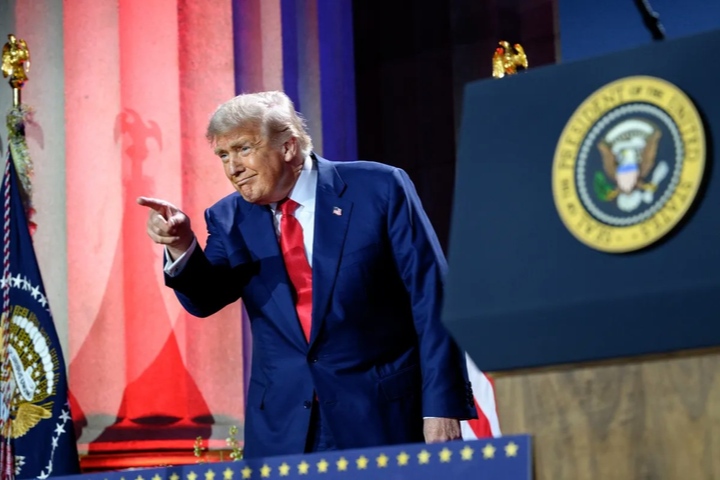 US President Donald Trump has been toying with tariffs all year long (Photo: The White House) |
PVC feels the bite
PVC window and profile makers have become a case study in how quickly this can bite. Trump’s China-focused stack – the longstanding 25% Section 301 duty on Chinese PVC plus the new “universal” 10% layer – has effectively shut Asian material out of the US. In doing so, he nudged US converters back towards domestic and USMCA-qualified suppliers just as EU exporters ran into the 15% tariff band at the border.
Related: Trump’s tariffs barely impact US plastics industry – Plastics Industry Association
On the other side of the Eurasian landmass, Beijing has struck back with anti-dumping duties of up to 74.9% on POM copolymers from the EU, US, Japan, and Taiwan – effective from May – intensifying the diversion of PVC compounds and downstream building products into Europe’s already over-supplied market and chewing through what is left of margins in a construction sector that never really recovered since the pandemic.
Faced with this, European producers are quietly mothballing lines, redirecting volume into intra-EU outlets and sounding out “non-aligned” destinations from North Africa to the Gulf, where predictability on tariffs now ranks high.
Related: Trump’s tariffs barely impact US plastics industry – Plastics Industry Association
On the other side of the Eurasian landmass, Beijing has struck back with anti-dumping duties of up to 74.9% on POM copolymers from the EU, US, Japan, and Taiwan – effective from May – intensifying the diversion of PVC compounds and downstream building products into Europe’s already over-supplied market and chewing through what is left of margins in a construction sector that never really recovered since the pandemic.
Faced with this, European producers are quietly mothballing lines, redirecting volume into intra-EU outlets and sounding out “non-aligned” destinations from North Africa to the Gulf, where predictability on tariffs now ranks high.
Mixed fortunes for PET
In packaging, the story is a bit more nuanced. A September move from the White House to crank up tariffs on PET and rPET imports to effective rates of around 50% for many origins snuffed out the long-standing cost advantage of Asian bottle-grade and rPET streams almost overnight and handed US recyclers and PET producers some much-needed breathing space.
For European PET makers, the 15% EU line into the US erodes pricing power, but the picture brightens when measured against Chinese rivals facing steeper cumulative duties and growing trade defences, leaving EU suppliers with a narrower, but still viable window in certain higher-spec or sustainability-driven segments.
At the same time, EU’s own circular economy agenda is reshaping the battlefield – producers are hardwiring “tariff pass-through” clauses into supply contracts and leaning harder on intra-EU recycled content to keep cross-Atlantic rPET flows – and their new tariff risks – from blowing up closed-loop packaging schemes.
Further up the value ladder, engineering thermoplastics are caught in an even more complex three-way confrontation. Key materials such as POM, polyamide 6, polycarbonate, and PBT from China continue to attract the 25% Section 301 duty into the US, on top of 2025’s new tariff layers, while Beijing’s own retaliation – anti-dumping duties of up to 74.9% on imported POM copolymer – has abruptly made China a far less attractive destination for EU, US, Japanese, and Taiwanese producers. Europe’s speciality producers, already running near full capacity, now face slumping China sales and a 15% US tariff wall. This pushes them towards higher-margin, low-carbon grades that premium buyers value for supply security, specs, and sustainability over merely price.
For European PET makers, the 15% EU line into the US erodes pricing power, but the picture brightens when measured against Chinese rivals facing steeper cumulative duties and growing trade defences, leaving EU suppliers with a narrower, but still viable window in certain higher-spec or sustainability-driven segments.
At the same time, EU’s own circular economy agenda is reshaping the battlefield – producers are hardwiring “tariff pass-through” clauses into supply contracts and leaning harder on intra-EU recycled content to keep cross-Atlantic rPET flows – and their new tariff risks – from blowing up closed-loop packaging schemes.
Further up the value ladder, engineering thermoplastics are caught in an even more complex three-way confrontation. Key materials such as POM, polyamide 6, polycarbonate, and PBT from China continue to attract the 25% Section 301 duty into the US, on top of 2025’s new tariff layers, while Beijing’s own retaliation – anti-dumping duties of up to 74.9% on imported POM copolymer – has abruptly made China a far less attractive destination for EU, US, Japanese, and Taiwanese producers. Europe’s speciality producers, already running near full capacity, now face slumping China sales and a 15% US tariff wall. This pushes them towards higher-margin, low-carbon grades that premium buyers value for supply security, specs, and sustainability over merely price.
European trade groups voice disappointment
All of this plays out against a macro backdrop that analysts say was always heading for a review. Years of heavy investment in crackers and polymer capacity have left the global petrochemicals sector oversupplied with ethylene, PE, and other basic building blocks; Trump’s tariffs do not resolve that oversupply, but they do accelerate the rationalisation, forcing uneconomic assets – often in Europe – to the front of the queue for idling or closure.
Trade group European Chemical Industry Council (Cefic, Brussels; www.cefic.org) has branded the 15% US line a “direct blow to European competitiveness” and is urging Brussels to match trade policy with rapid relief on energy and regulations, while Plastics Europe (Brussels; www.plasticseurope.org) warns that reciprocal duties on polymers risk unpicking supply chains that have held up manufacturing across the continent.
Related: EU associations respond to shifting polymer flows amid third-party tariffs
On the ground, finance teams are rewriting the rule book – contracts are shorter, customer portfolios are pruned more aggressively, and origin engineering via tariff-favoured routes has become core competence rather than niche optimisation.
In Brussels and the national capitals, the response is a blend of confrontation and pragmatism. Industry and policymakers alike are working both to contain escalation under the new US-EU framework and to carve out as much breathing space as possible for chemicals and plastics, whether through sectoral exemptions, state aid or a broader “competitiveness package” aimed at preventing further deindustrialisation.
At the same time, Europe is sharpening its own trade tools, with a denser pipeline of anti-dumping and anti-subsidy probes targeting Chinese chemicals and polymers diverted from the US market, and companies are quietly rebalancing their export mix towards Africa, Latin America, and within the single market itself, while exploring US and Asian localisation to take sensitive chains out of the line of tariff fire.
Trade group European Chemical Industry Council (Cefic, Brussels; www.cefic.org) has branded the 15% US line a “direct blow to European competitiveness” and is urging Brussels to match trade policy with rapid relief on energy and regulations, while Plastics Europe (Brussels; www.plasticseurope.org) warns that reciprocal duties on polymers risk unpicking supply chains that have held up manufacturing across the continent.
Related: EU associations respond to shifting polymer flows amid third-party tariffs
On the ground, finance teams are rewriting the rule book – contracts are shorter, customer portfolios are pruned more aggressively, and origin engineering via tariff-favoured routes has become core competence rather than niche optimisation.
In Brussels and the national capitals, the response is a blend of confrontation and pragmatism. Industry and policymakers alike are working both to contain escalation under the new US-EU framework and to carve out as much breathing space as possible for chemicals and plastics, whether through sectoral exemptions, state aid or a broader “competitiveness package” aimed at preventing further deindustrialisation.
At the same time, Europe is sharpening its own trade tools, with a denser pipeline of anti-dumping and anti-subsidy probes targeting Chinese chemicals and polymers diverted from the US market, and companies are quietly rebalancing their export mix towards Africa, Latin America, and within the single market itself, while exploring US and Asian localisation to take sensitive chains out of the line of tariff fire.
2026: Bracing for more
The outlook for 2026 is anything but calm. A further intensifying of Trump’s 15% baseline, or a new wave of sector-specific surcharges on EU plastics and chemicals, could force Brussels to activate the full menu of countertariffs it has kept in reserve, deepening the squeeze on polyolefins, PVC, and a host of downstream products. EU producers are already planning for that scenario – diversification efforts into India, Southeast Asia, and the Middle East are likely to intensify; US investment is set to become an even more important safeguard; and scrutiny of Chinese “overspill” into Europe might harden into more systematic trade-defence measures.
The expectation in many boardrooms is stark – more capacity closures, some resilience, and perhaps even opportunity, in differentiated, low-carbon engineering plastics, and another year in which “beautiful” tariffs remain the dominant, and deeply destabilising, word in the sector’s vocabulary.
The expectation in many boardrooms is stark – more capacity closures, some resilience, and perhaps even opportunity, in differentiated, low-carbon engineering plastics, and another year in which “beautiful” tariffs remain the dominant, and deeply destabilising, word in the sector’s vocabulary.
| Year-Enders 2025: With the year on its way out, Plasteurope.com is taking stock of the European plastics industry and related sectors. From the impact of US tariffs and the state of the European economy to polymer price trends and the recycling, energy, and gas markets, we’re bringing you an analysis of the year that was, with hints of what you can expect in 2026. Our goal, simple as always, is to help you make better business decisions with a clearer understanding of the trends, challenges, and transformations in the industry, with insights from expert voices in each sector concerned. |
16.12.2025 Plasteurope.com [259089-0]
Published on 16.12.2025