


RESEARCH
Spanish tech centre Aimplas completes project on reducing environmental impact of pharmaceutical production / Advances in extrusion and solvent recovery
— By Plasteurope.com correspondent —
Spanish technology centre Aimplas (Valencia; www.aimplas.net) has announced the successful completion of a four-year research project devised to reduce the environmental impact associated with the design, manufacture, use, and disposal of pharmaceutical products. The project, named Eternal, was coordinated by Aimplas and conducted by a consortium comprising 16 companies and research groups across the pharmaceutical value chain.
Spanish technology centre Aimplas (Valencia; www.aimplas.net) has announced the successful completion of a four-year research project devised to reduce the environmental impact associated with the design, manufacture, use, and disposal of pharmaceutical products. The project, named Eternal, was coordinated by Aimplas and conducted by a consortium comprising 16 companies and research groups across the pharmaceutical value chain.
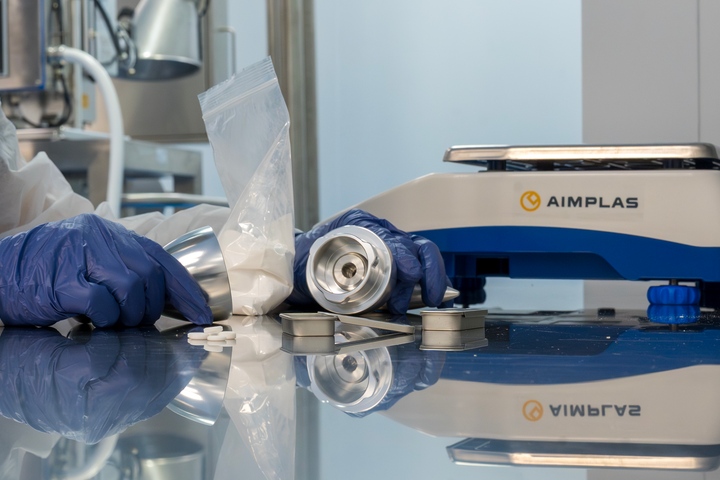 Aimplas coordinated the four-year Eternal project, which examined ways to reduce the environmental impact of pharmaceutical production (Photo: Aimplas) |
Throughout the project, which was funded by the Horizon Europe programme, seven industrial case studies covered various stages of the value chain. Achievements included new continuous manufacturing technologies and solvent recycling, developed together with pharmaceutical companies including Angelini Pharma (Rome; www.angelinipharma.com) and Laboratorio Reig Jofre (Barcelona, Spain; www.reigjofre.com).
Related: Aimplas joins Superpan research project
Aimplas said green chemistry and resource recovery solutions had been driven by AstraZeneca, while biotechnological developments were led by MyBiotech (Überherrn, Germany; www.mybiotech.de) and Saarland University (Saarbrücken, Germany; www.uni-saarland.de). New methodologies were also developed to integrate sustainability criteria into industrial decision-making.
Continuous manufacturing and solvent recovery
Citing two examples, Aimplas said, “One of the areas where the greatest progress has been achieved is continuous manufacturing. In collaboration with Angelini Pharma, the project verified the potential of twin-screw extrusion technology to simplify production processes, eliminate energy-intensive stages, and reduce water consumption in pharmaceutical manufacturing.
“In parallel, together with Laboratorio Reig Jofre, continuous processes were developed for the production of nanoparticles and liposomes for drug delivery applications, incorporating digital tools capable of predicting final product characteristics while also enabling the reuse of solvents employed during manufacturing.”
“In parallel, together with Laboratorio Reig Jofre, continuous processes were developed for the production of nanoparticles and liposomes for drug delivery applications, incorporating digital tools capable of predicting final product characteristics while also enabling the reuse of solvents employed during manufacturing.”
Environmental impact and policy recommendations
The Eternal project also examined the behaviour of pharmaceuticals in the environment. Aimplas said project partners Universidade de Aveiro (Aveiro, Portugal; www.ua.pt) and the UK Centre for Ecology & Hydrology (Bangor; www.ceh.ac.uk) “investigated the occurrence, fate, and environmental impacts of active pharmaceutical ingredients and their metabolites, generating new data to improve environmental risk assessment and support future evidence-based regulatory decisions”.
Rleated: Aimplas to develop recyclable lightweight composite panels for transport sector
The research team also developed recommendations designed to speed up the transition towards a more sustainable pharmaceutical sector. Aimplas said a policy brief, titled Towards a Green Pharmaceutical Future in Europe, advocated “integrating environmental criteria throughout the entire life cycle of medicines, and proposes measures to promote innovation, competitiveness, and sustainability across the European pharmaceutical industry”.
Rleated: Aimplas to develop recyclable lightweight composite panels for transport sector
The research team also developed recommendations designed to speed up the transition towards a more sustainable pharmaceutical sector. Aimplas said a policy brief, titled Towards a Green Pharmaceutical Future in Europe, advocated “integrating environmental criteria throughout the entire life cycle of medicines, and proposes measures to promote innovation, competitiveness, and sustainability across the European pharmaceutical industry”.
08.10.2026 Plasteurope.com [261135-0]
Published on 08.10.2026