


CYCLIZE
Second chemical recycling pilot plant commissioned / Former Covestro exec-committee member Klaus Schäfer on board
— By Plasteurope.com staff —
Recycling technology developer Cyclize (Stuttgart, Germany; www.cyclize.de) commissioned another pilot plant in September 2026.
At the PCK Raffinerie site in Schwedt, Germany, the start-up is testing its process for converting hard-to-recycle plastics waste into synthesis gas using plasma and added CO₂. The gas can be used as a feedstock for methanol, isocyanates, and oxo-alcohols. Cyclize already operates a similar plant in Stuttgart-Vaihingen, Germany.
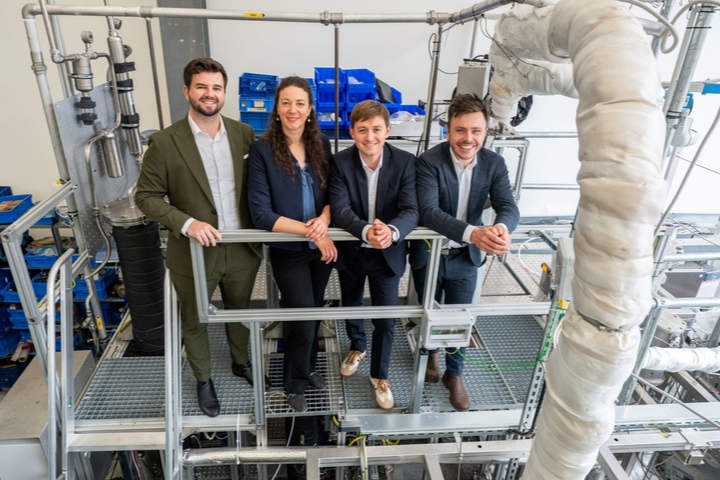 Cyclize’s founding team: Dominik Novakovic (CFO), Maike Lambarth (CEO), Jan Stein (COO), and Stephan Renninger (l. to r.; Photo: Jens Volle/Cyclize) |
As the next step, the company plans to build its first commercial chemical recycling plant at a “European chemical production site”. The facility is expected to have a processing capacity of around 300 kg/h, and to be commissioned within the next two years, co-founder and chief operating officer Jan Stein told Plasteurope.com.
Long-term offtake agreements have already been signed for the plant. Subsequently, a further scale-up to approximately 3,000 kg/h is planned. Cyclize also estimates that construction of this large-scale plant will take two years.
Broader feedstock range than pyrolysis
According to Stein, the Cyclize process can handle a considerably broader range of input materials than conventional pyrolysis, as the waste is broken down into the basic building blocks of carbon monoxide and hydrogen.
Related: Covestro starts up pilot plant for chemical recycling of elastomers
The process also offers greater selectivity in terms of the target product. While some of the carbon in pyrolysis ends up in light gases that are generally burned off, the Cyclize process converts almost the entire organic component into synthesis gas. “In short, we recycle the residue of the residue,” Stein said. By using standardised plasma units, the company can scale up the all-electric technology on a modular basis.
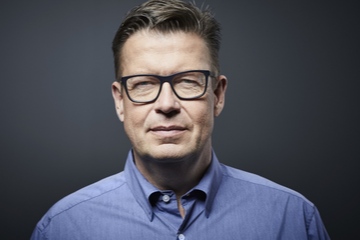 Klaus Schäfer (Photo: Covestro) |
Cyclize puts the investment costs for its first commercial plant at tens of millions of euros. The project is to be financed through a Series-A funding round, which is nearing completion, as well as public funding.
Klaus Schäfer, former chief technology officer at plastics group Covestro (Leverkusen, Germany; www.covestro.com) is responsible for implementing the industrialisation process. Schäfer has supported Cyclize since its first financing round in 2024, both as an investor and chair of the advisory board.
Klaus Schäfer, former chief technology officer at plastics group Covestro (Leverkusen, Germany; www.covestro.com) is responsible for implementing the industrialisation process. Schäfer has supported Cyclize since its first financing round in 2024, both as an investor and chair of the advisory board.
From synthetic fuels to plastics waste recycling
Cyclize was established as a spin-off from the University of Stuttgart in 2023. The company’s roots date back to 2018, when Maike Lambarth and Stephan Renninger began developing a plasma technology for the utilisation of CO₂ at the university’s Institute of Photovoltaics.
The process was initially intended for the production of synthetic marine fuels. As this approach proved too energy-intensive, the research team shifted its focus to converting plastics waste and CO₂ into synthesis gas. In addition to Lambarth, Renninger, and Stein, the founding team also includes chief financial officer Dominik Novakovic.
The process was initially intended for the production of synthetic marine fuels. As this approach proved too energy-intensive, the research team shifted its focus to converting plastics waste and CO₂ into synthesis gas. In addition to Lambarth, Renninger, and Stein, the founding team also includes chief financial officer Dominik Novakovic.
23.10.2026 Plasteurope.com [261194-0]
Published on 23.10.2026