


CATALYXX
Commercial-scale plant for renewable chemicals in Portugal / Consortium targets cost-competitive, carbon-negative products
— By Heather Arnest Liesch —
Catalyxx (Sevilla, Spain; www.catalyxxinc.com) has announced a commercial-scale plant in Sines, Portugal, to produce renewable butanol, hexanol, and octanol from bioethanol. The EUR 120 mn facility is designed for a production capacity of 15,000 t/y of biobased alcohols. Construction is scheduled to begin in the fourth quarter of 2026.
Catalyxx (Sevilla, Spain; www.catalyxxinc.com) has announced a commercial-scale plant in Sines, Portugal, to produce renewable butanol, hexanol, and octanol from bioethanol. The EUR 120 mn facility is designed for a production capacity of 15,000 t/y of biobased alcohols. Construction is scheduled to begin in the fourth quarter of 2026.
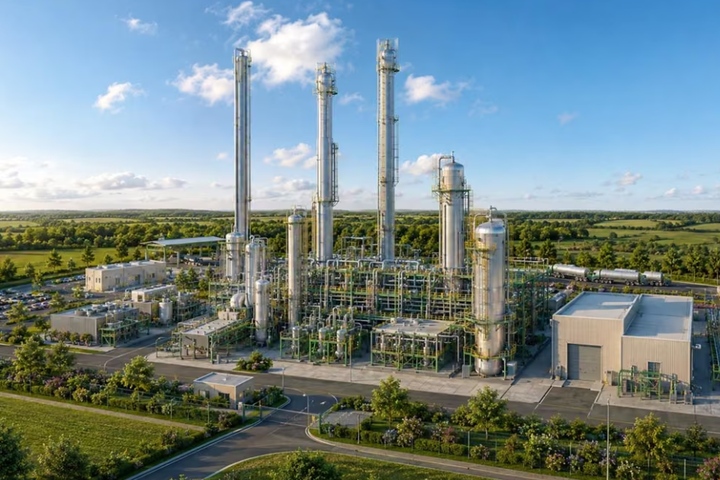 The RenewChem consortium led by Catalyxx plans to start construction of the 15,000 t/y biochemicals plant in Q4 2026 (Photo: Catalyxx) |
The products are intended as drop-in replacements for fossil-derived chemical intermediates used across the chemicals and plastics industries. Catalyxx estimates production costs for biobased butanol at around 13.6% below those of petrochemical equivalents.
The Spanish company said its demonstration plant in Sevilla has validated the proprietary catalytic process under continuous operating conditions. “The Sines plant builds directly on this foundation,” the company said.
Strong backing from public and private interests
The project is being developed by the RenewChem consortium, led by Catalyxx and comprising its Portuguese subsidiary Catalyxx Iberica (Lisbon), Arkema (Colombes, France; www.arkema.com), Evonik (Essen, Germany; www.evonik.com), and Magfi (Marsaskala, Malta; www.magfi.eu).
The plant’s construction is backed by a combination of private investment and public funding, including support from the European Investment Bank (EIB), the European Innovation Council (EIC), and investor Beka.
Related: EU Commission launches bioeconomy strategy aimed at substitution of fossil fuels
The latest funding comes from the Circular Bio-based Europe Joint Undertaking (CBE JU), which has awarded the consortium EUR 20 mn as one of its flagship projects to accelerate industrial deployment of biobased chemicals in Europe.
The plant’s construction is backed by a combination of private investment and public funding, including support from the European Investment Bank (EIB), the European Innovation Council (EIC), and investor Beka.
Related: EU Commission launches bioeconomy strategy aimed at substitution of fossil fuels
The latest funding comes from the Circular Bio-based Europe Joint Undertaking (CBE JU), which has awarded the consortium EUR 20 mn as one of its flagship projects to accelerate industrial deployment of biobased chemicals in Europe.
Diversified feedstock as key advantage
Catalyxx said the Sines facility will be the first commercial-scale European plant producing renewable higher alcohols from bioethanol. The process converts ethanol into butanol, hexanol, and octanol that are molecularly identical to their petrochemical equivalents and “fully compatible with existing industrial infrastructure, applications, and value chains”.
Related: Algenesis, P2 Science to develop fully biobased isocyanates as drop-in solutions
The chemical intermediates are used in products including coatings, adhesives, resins, lubricants, surfactants, home and personal care products, as well as sustainable fuels.
The plant is to consume around 22,400 t/y of bioethanol feedstock. According to Catalyxx, ethanol offers a widely available, locally produced feedstock that can be sourced from sugar crops, cereals, cellulosic biomass, and carbon-derived ethanol.
Related: Algenesis, P2 Science to develop fully biobased isocyanates as drop-in solutions
The chemical intermediates are used in products including coatings, adhesives, resins, lubricants, surfactants, home and personal care products, as well as sustainable fuels.
The plant is to consume around 22,400 t/y of bioethanol feedstock. According to Catalyxx, ethanol offers a widely available, locally produced feedstock that can be sourced from sugar crops, cereals, cellulosic biomass, and carbon-derived ethanol.
Offtake agreements in place
Commercial backing for the project is already in place. Arkema has signed a five-year offtake agreement covering up to 100% of the plant’s output, with the option to extend another five years. Mitsubishi and Covestro have also expressed interest in Catalyxx’s biochemicals, and the company said its technology has already been licensed in India.
Catalyxx expects annual revenues of around EUR 30 mn during the plant’s first five years of operation, rising to EUR 70.8 mn longer term.
The plant’s annual production is expected to represent approximately 1.7% of current European butanol demand. Catalyxx has, however, positioned the Portuguese site as the first in a series of commercial plants planned internationally; the company previously said it intends to replicate the technology in Brazil and the US.
Catalyxx expects annual revenues of around EUR 30 mn during the plant’s first five years of operation, rising to EUR 70.8 mn longer term.
The plant’s annual production is expected to represent approximately 1.7% of current European butanol demand. Catalyxx has, however, positioned the Portuguese site as the first in a series of commercial plants planned internationally; the company previously said it intends to replicate the technology in Brazil and the US.
Towards decarbonisation
According to Catalyxx, the Sines plant is expected to avoid around 105,000 t/y of CO₂ emissions, a key step towards decarbonising an industry that still relies heavily on fossil feedstock.
More broadly, the company estimates that deployment of its technology across European butanol production could reduce emissions by more than 3 mn t/y while helping improve the region’s supply security for key chemical intermediates.
Related: Commission’s Made in Europe proposal targets competitiveness, decarbonisation
“In the current geopolitical and industrial context, strengthening Europe’s security of supply and strategic autonomy in critical chemical value chains has become increasingly important,” said Catalyxx CEO Joaquín Alarcón. “We believe Catalyxx can play a meaningful role in that transition.”
More broadly, the company estimates that deployment of its technology across European butanol production could reduce emissions by more than 3 mn t/y while helping improve the region’s supply security for key chemical intermediates.
Related: Commission’s Made in Europe proposal targets competitiveness, decarbonisation
“In the current geopolitical and industrial context, strengthening Europe’s security of supply and strategic autonomy in critical chemical value chains has become increasingly important,” said Catalyxx CEO Joaquín Alarcón. “We believe Catalyxx can play a meaningful role in that transition.”
Special status accelerates approval process
The project has been granted Project of National Interest status by the Portuguese government, which provides an accelerated regulatory pathway. The company said key environmental approvals have already been secured, adding that purchase orders for front-end engineering work have been placed as the project advances towards construction.
Related: Ineos sues Flemish government over Project One construction delays
“This project will not only accelerate the defossilisation of the chemical industry, but also position Portugal as a European leader in sustainable industrial innovation,” said Alarcón.
Catalyxx expects the facility to create more than 650 high-skilled jobs along the value chain and contribute around EUR 12.8 mn in tax revenues.
Related: Ineos sues Flemish government over Project One construction delays
“This project will not only accelerate the defossilisation of the chemical industry, but also position Portugal as a European leader in sustainable industrial innovation,” said Alarcón.
Catalyxx expects the facility to create more than 650 high-skilled jobs along the value chain and contribute around EUR 12.8 mn in tax revenues.
23.07.2026 Plasteurope.com [260673-0]
Published on 23.07.2026
 German version of this article...